
On-Site Nursery & Plant Propagation

The nursery at Pilale Bay Farms is a central component of our land restoration strategy. We utilize this facility to propagate food crops, orchard trees, and culturally significant lei-making plants that support both agricultural production and traditional uses.
Seedlings, cuttings, and young plants are grown on site to establish new orchard areas, increase planting density, and ensure a reliable supply of locally adapted planting material. This approach allows the farm to expand efficiently as new development areas come online while maintaining strong plant health and genetic performance under local conditions.
By producing our own planting stock, we reduce outside inputs and build long-term resilience into the operation. As capacity increases, selected nursery plants will also be made available to local growers, community projects, and cultural practitioners.
Starting the Next Generation
Seeds and cuttings are started in trays and containers under controlled conditions. Careful labeling and selection help maintain productive varieties and support future orchard expansion.


Papaya
Papaya seeds started on-site to produce vigorous planting stock for future orchard expansion and ongoing production.
native reforestation
Native koa seedlings propagated for reforestation, windbreaks, and long-term restoration of local ecological function.


Vegetable Starts
Seasonal vegetable starts grown in small batches to support diversified, flexible food production for family and community use.
Diversified Fruit Crops
Kalo ʻoha (young shoots from the makua corm) established in pots to multiply planting material. This method allows many new plants to be generated from a single parent while the next māla is being prepared.


Kou seedlings being moved to full-sun grow-out areas. As young plants develop, they are gradually transitioned from protected nursery conditions to field conditions, preparing them for successful establishment in the landscape.
Growing for field Planting.
Young plants are grown out until they are ready for field establishment. This staged approach improves survival rates and allows planting to match seasonal conditions and new development areas.

Mixed tree species in full-sun grow-out under protected conditions. Fenced enclosures and overhead irrigation help young plants develop strong root systems while protecting them from deer, pigs, and dry periods.


Ti propagation for future planting. Expanding reliable on-farm supply of lei materials used for cultural, educational, and community needs.
Early Propagation Stages

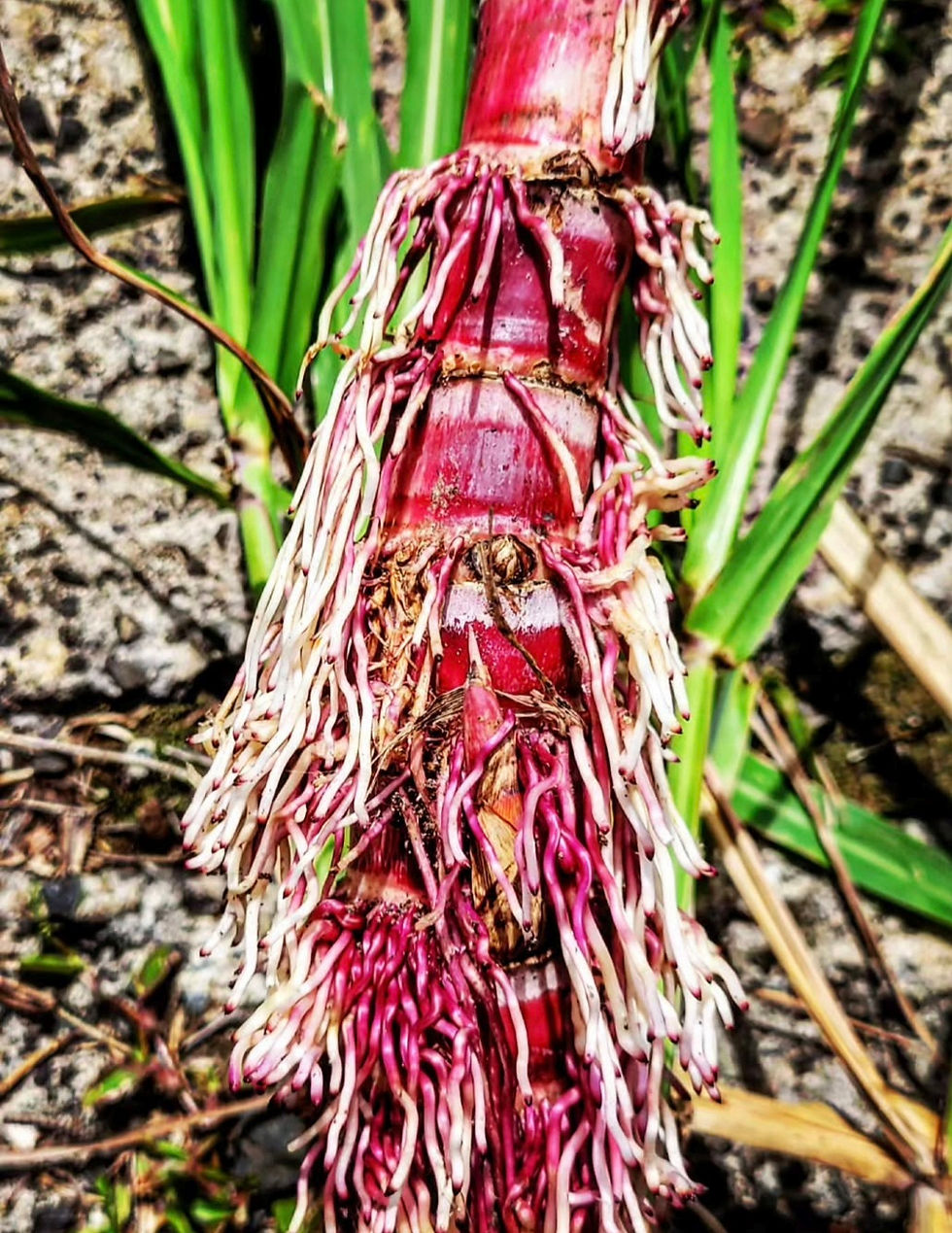
Much of the nursery work at Pilale Bay Farms begins with simple propagation techniques that allow a single plant to produce many new starts. Air layering, stem cuttings, water-rooted cuttings, node sections, and plant divisions are used to generate new planting material before plants are moved into containers for grow-out.
These early stages focus on developing strong roots and multiplying proven varieties efficiently. This hands-on approach allows the farm to expand production, preserve high-performing plants, and build large numbers of field-ready starts using minimal outside inputs.


Air layering in progress. This method allows new plants to be established from mature branches while still attached to the parent tree, producing strong, field-ready starts that retain the characteristics of proven plants.


Division of a mature makua into large planting-sized ʻōha and smaller starter pieces. This approach multiplies planting material from each harvest while maintaining a continuous supply for future māla establishment.
Ti cuttings staged in a water-rooting container to initiate root development before planting. Preparing large batches at once allows the farm to efficiently expand on-site production of lei and cultural plant materials.
Plumeria cutting with roots established prior to potting. Water-rooting improves early survival and supports steady expansion of flowering plants used for lei and landscape plantings.